
Why Minimalism Gets Blamed for Making Organization Feel Impossible
For many people, the word organization has become tangled up with minimalism - a specific aesthetic and philosophy that's been heavily promoted across design media and social platforms. The result is that plenty of readers approach home organization already feeling like they don't qualify: they have too many belongings, the wrong kind of things, or a home that will never look like the curated spaces they've seen photographed.
That's a problem worth addressing directly. Minimalism and organization are not the same discipline. One is a philosophy about what you choose to own; the other is a practical set of skills for managing whatever you have. Conflating them creates a false barrier that stops people from making real improvements to how their home functions.
Myth
Minimalism and organization are the same thing - you have to embrace one to get the other.
Fact
Minimalism is a design and lifestyle philosophy about owning fewer things. Organization is a practical skill about managing what you have effectively. They are related but entirely separate.
Plenty of people live in sparse, minimalist spaces that are actually disorganized - things are just harder to spot. Conversely, many households with full shelves, hobby collections, and kids' toys run with excellent functional systems. The goal of organization is that you can find what you need, when you need it, and that your space supports daily life without constant friction. Aesthetics are optional. If the minimalist look appeals to you, that's a valid personal choice - but it isn't a prerequisite for having a home that works.
Myth
To get organized, you first need to get rid of most of your stuff.
Fact
Reducing possessions can make organizing easier, but it isn't required - and doing it in the wrong order wastes effort.
Many people stall on organizing because they believe they must first complete a massive purge. In reality, the most sustainable path is to understand your space and habits first, then decide what genuinely isn't serving you. Dramatic all-at-once purges often lead to discarding things you later need, or simply shifting clutter from one location to another. A measured approach - one area or category at a time - tends to stick far longer. The article Decluttering Without the Overwhelm walks through exactly that kind of sustainable, lower-pressure method.
Myth
An organized home should look a certain way - clean lines, neutral colors, nothing on the counters.
Fact
Visual style has nothing to do with whether a home is functionally organized. A system that works is one you can actually maintain.
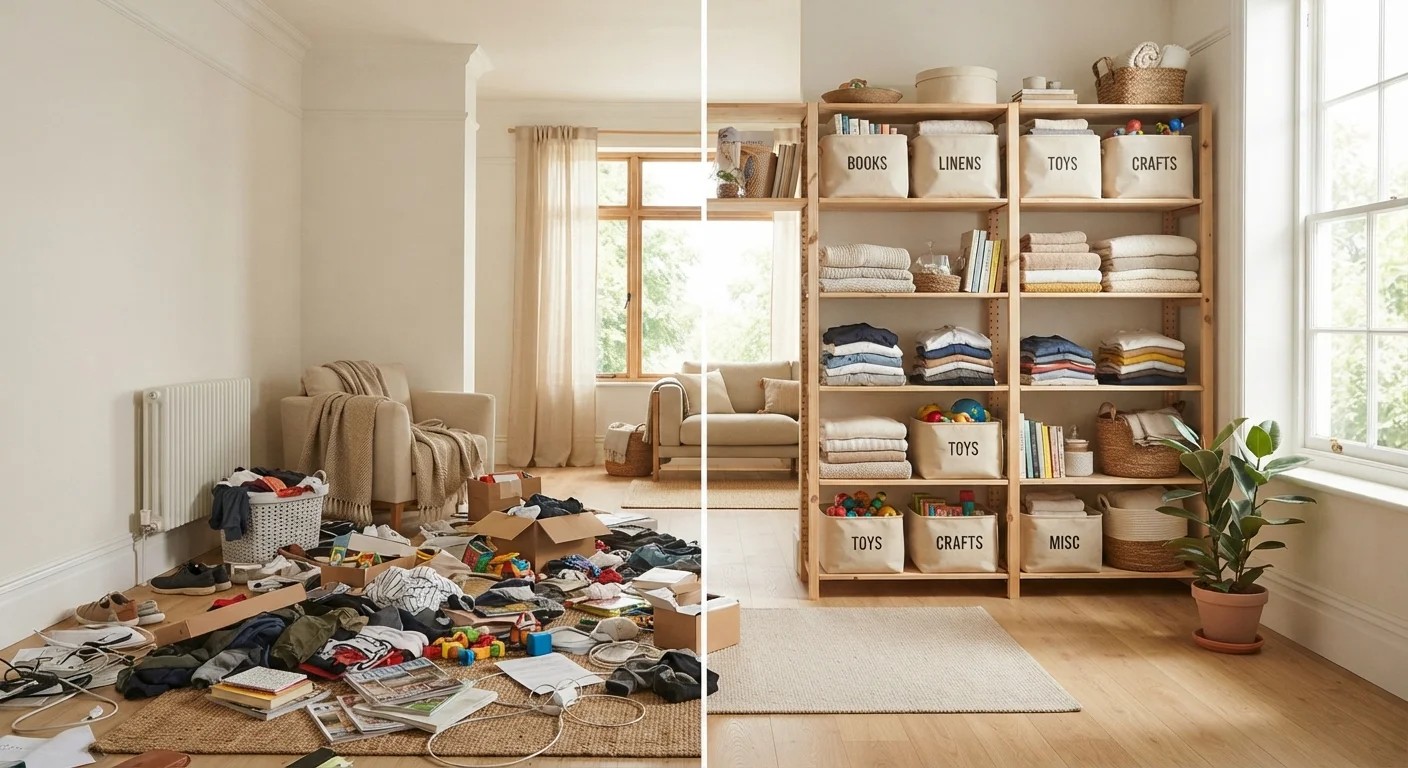
Social media has merged the concept of organization with a specific aesthetic - usually white storage bins, labeled containers, and bare surfaces. That image works for some households and is actively counterproductive for others. A home office covered in color-coded Post-it notes and stacked reference books can be highly organized if the person using it knows exactly where everything is. Likewise, a home that looks tidy on the surface can still feel chaotic if the underlying systems don't match how the household actually functions.
Myth
Once you get organized, you're done - you just have to maintain it.
Fact
Organization requires ongoing, lightweight habits - not a one-time transformation followed by passive maintenance.
The idea that you do a big organizational overhaul once and then simply preserve it is one of the most discouraging myths, because it sets people up to feel like failures when things inevitably shift. Households change: people move in or out, kids grow, hobbies evolve, and buying patterns shift. Effective organization involves simple recurring habits - a weekly reset, a seasonal review of what's still in active use, and a consistent approach to what comes into the home. Small practices like a one-in, one-out rule are far more effective long-term than periodic dramatic overhauls.
Myth
Sentimental items and collections are the enemy of an organized home.
Fact
Meaningful objects are not clutter - the problem arises when storage and display systems don't account for them properly.
One of the reasons people resist organizing is a fear that they'll be pressured to part with things that matter to them. But sentimental items, hobby collections, and inherited objects are a normal part of most households. The organizational challenge isn't to eliminate them - it's to give them a designated place that fits their actual volume. A collection of 200 books needs different shelving than a collection of 20. Craft supplies need accessible storage, not a distant closet. The issue is a mismatch between what you own and how your space accommodates it, not the items themselves.
Understanding where these myths come from - and why they persist - makes it much easier to approach your own space with a clearer, more realistic set of expectations.
What Functional Organization Actually Looks Like
A well-organized home isn't defined by how few things it contains or how it photographs. It's defined by whether the people living in it can move through daily routines without unnecessary friction. That means different things for a family with young children, a solo renter in a studio apartment, and a couple sharing a multi-bedroom house with two distinct sets of hobbies.
Organization Is Personal, Not Prescriptive
There is no universally correct number of belongings, no approved aesthetic, and no single system that works for every household. What matters is whether your home supports the way you actually live. Any approach that creates more stress than it relieves is worth reconsidering.
The most durable organizational systems share a few common traits: things are stored where they're actually used, there's a clear and simple way to return items to their place, and the system doesn't demand more maintenance effort than the household is realistically able to give it. Common storage myths - like the idea that more bins automatically solve clutter - can also derail this process before it starts.
If you're unsure where to begin, the most useful first step is usually observation rather than action: spend a few days noticing where things pile up, what you can never find, and which areas of your home cause the most daily frustration. Those friction points are where organization can make the biggest practical difference.
Don't Discard Before You Organize
A common mistake is getting rid of items impulsively during a decluttering push, only to replace them later. Before deciding what to remove, first understand how you use your space and what your household actually needs. Rushing the process often leads to regret and repurchasing - which adds both cost and new clutter. See the difference between decluttering and organizing to understand why sequence matters.
From there, building a few consistent daily habits tends to matter far more than any single organizing session - no matter how thorough it is.