
Two Words That Get Used as One
Ask most people what they mean when they say they need to "get organized," and they'll describe a mix of two very different activities: getting rid of things and finding better places for things. The problem is that conflating these two steps - or doing them in the wrong order - is exactly why so many organization projects stall or unravel within weeks.
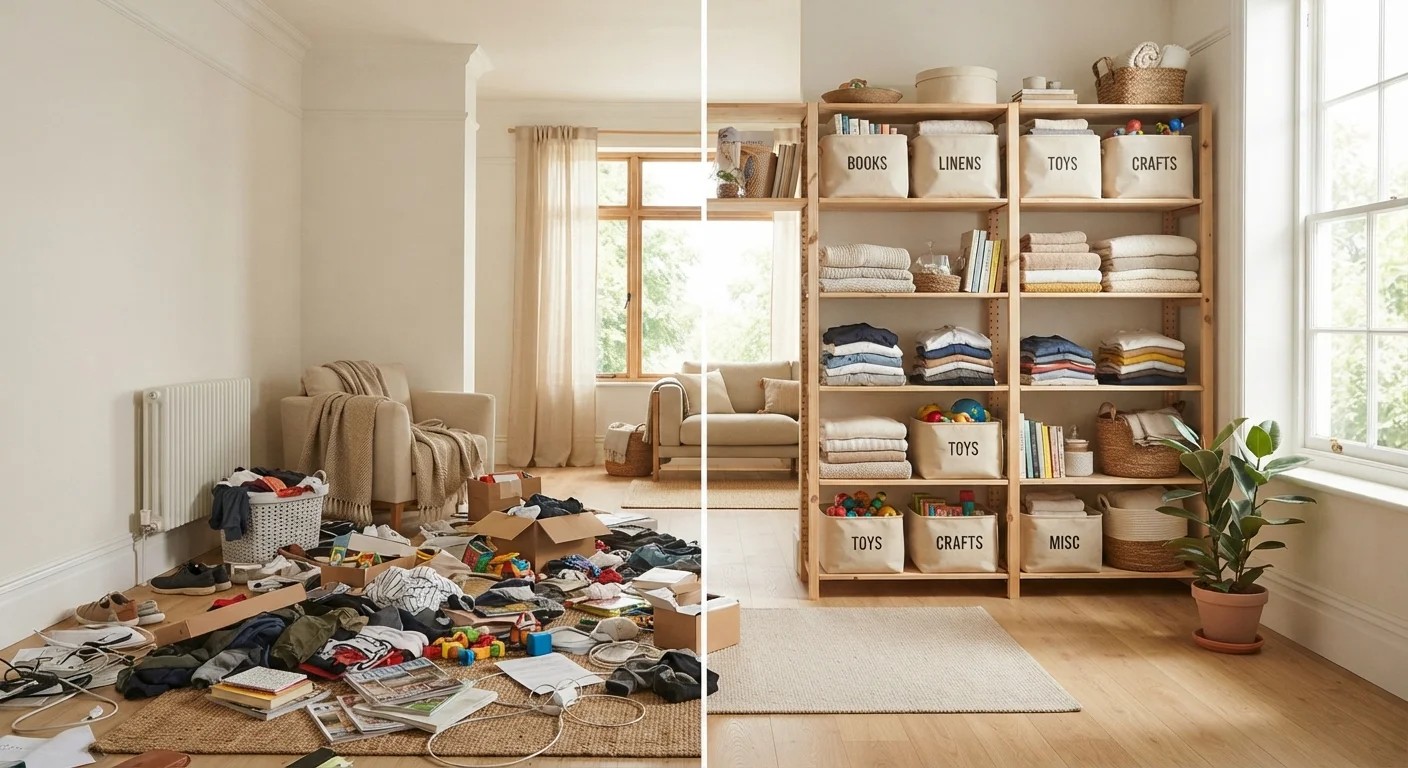
Decluttering and organizing are related, but they are not the same action. Each asks a different question. Decluttering asks: does this belong in my life? Organizing asks: where does this live so I can find and use it reliably? Until you've answered the first question, the second one is premature.
This distinction matters practically. When you buy bins, drawer dividers, or shelf systems before deciding what to keep, you risk designing storage around things you'll eventually remove anyway. The result is an organized-looking space that still doesn't function well - and often costs more to maintain than it's worth.
What Decluttering Actually Involves
Decluttering is fundamentally a decision-making process. You move through your belongings and make a call on each one: keep, donate, discard, or relocate. It isn't about minimalism or owning as little as possible - it's about making sure everything you keep is something you actually use, need, or value enough to store and maintain.
80%
Of clutter is from indecision, not lack of space
Professional organizers commonly cite indecision as the primary driver of accumulation, rather than insufficient storage capacity.
1 in 4
US households report a garage too cluttered to park in
Survey data from the National Association of Professional Organizers has highlighted that excess accumulation - not storage shortage - is the dominant factor in unusable spaces.
The friction in decluttering is usually emotional, not logistical. Items associated with sunk cost, guilt, or future hypotheticals ("I might need this someday") are the hardest to act on. That's normal. What matters is developing a decision framework that works for your household rather than adopting someone else's rules wholesale. Our guide on decluttering without the overwhelm covers approaches that work at a manageable pace for real households.
A useful signal that you're still in decluttering territory: you're asking yourself whether to keep something. Once that question disappears and you're only thinking about placement, you've moved into organizing.
What Organizing Actually Involves
Organizing is about creating reliable systems for the items you've committed to keeping. A system is reliable when it's easy to use consistently - meaning it takes roughly the same effort to put something back as it does to take it out. If returning an item requires more effort than retrieving it, the system will erode.
Good organization is also specific to a household's actual behavior, not an idealized version of it. A system that requires everyone in the home to carefully re-fold and stack items after each use will fail in most households. One that allows things to be dropped into a labeled bin will usually hold. Popular organization frameworks differ mainly in how they approach this behavioral alignment.
Test Your System Before Committing to It
Before purchasing storage containers or furniture, trial your organizational categories using temporary labels and boxes you already own. Live with the arrangement for a week or two. If it holds up under real daily use, then it's worth investing in permanent solutions. This approach saves money and prevents the common outcome of buying storage that doesn't fit actual behavior.
The goal of organizing isn't visual perfection - it's functional predictability. You should be able to find what you need without searching, and return it without thinking. That's the benchmark worth aiming for.
Why Sequence Is the Hidden Variable
The most common mistake in home organization projects is reaching for storage solutions before completing the decluttering step. It's understandable - buying containers feels productive, and arranging things neatly provides immediate visual satisfaction. But it creates a structural problem: you've now built a system around a volume of items that may be too large for the space to handle sustainably.
When decluttering comes first, the organizing step becomes simpler and cheaper. You're working with a smaller, curated set of items. The right container sizes become obvious. Categories emerge naturally. And maintenance - the part most people overlook - becomes less demanding because there's less to manage.
If you're starting with a home that feels chaotic throughout, the sequencing challenge can feel daunting. Our guide to starting from scratch walks through how to approach a whole-house effort without losing momentum. And if a mid-process slump hits - when things look worse before they look better - that's a recognized part of the process, not a sign of failure.
Maintaining the Difference Over Time
Once both steps are complete, the distinction doesn't disappear - it shifts into a maintenance rhythm. Day-to-day tidying is neither decluttering nor organizing; it's simply using the system you've built. But periodically, usually when a space starts feeling congested again, the decluttering question resurfaces: has something crept back in that doesn't belong?
Homes are not static. Purchases, gifts, and life changes all add volume over time. Treating decluttering as a one-time event rather than an occasional habit is one reason organized spaces gradually revert. Building in a light review - even just once or twice a year for key areas - keeps the underlying system from getting overloaded.
For households where the organizing step goes well but the space still feels unsettled, the issue may not be volume at all - it may be that the system isn't well-matched to how the space is actually used. That's a different problem, and it has different solutions.
Organization Frameworks Aren't One-Size-Fits-All
Methods like KonMari, the OHIO rule, or zone-based systems all approach the declutter-then-organize sequence differently, and what works well in one household may not translate to another. The underlying principle - reduce first, then systematize - is consistent across approaches, even when the specific steps vary. See our overview of minimalism myths for a grounded look at what organized living actually requires.