
Why Roundabouts Still Confuse Confident Drivers
Roundabouts are statistically safer than signalized intersections - the Federal Highway Administration notes they significantly reduce fatal and injury crashes at converted sites. But safer design doesn't automatically produce safer driving. Many drivers develop habits at smaller, quieter roundabouts and then carry those habits into busier, multi-lane versions where the stakes are higher.
The mistakes below aren't rookie errors. They show up regularly across all experience levels because roundabout rules are genuinely underexplained in most driver education programs and reinforced inconsistently by road signage. Understanding where the rules actually sit - and why confusion happens - is more useful than a simple checklist. For a broader look at how perception shapes junction decisions, see why drivers misjudge speed at junctions.
Failing to yield to circulating traffic when entering the roundabout.
Why it happens: Many drivers treat the roundabout entry like a merge rather than a yield, especially when the roundabout is moving quickly and gaps appear briefly.
Choosing the wrong lane at entry and then drifting across lanes mid-roundabout.
Why it happens: Drivers often decide which exit they want after they've already entered, rather than selecting the correct approach lane in advance.
Not signalling when exiting the roundabout.
Why it happens: Most drivers focus on signalling when entering, which is correct, but then forget that a right-turn signal on exit tells pedestrians and waiting drivers that you're leaving the circle.
Stopping unnecessarily inside the roundabout when there is no hazard.
Why it happens: Uncertainty about priority, hesitation about lane position, or reacting to another driver's erratic movement causes some drivers to brake sharply or stop inside the circle.
Ignoring pedestrians crossing the exit road after leaving the roundabout.
Why it happens: Attention is so focused on navigating the circle itself that drivers treat exiting as 'done' before they've fully cleared the pedestrian crossing on the exit road.
Tailgating the vehicle ahead through the roundabout rather than maintaining a safe following distance.
Why it happens: Drivers are focused on gaps in circulating traffic and unconsciously close the gap to the vehicle in front, assuming the roundabout constrains speed enough to make it safe.
Applying This at Multi-Lane Roundabouts
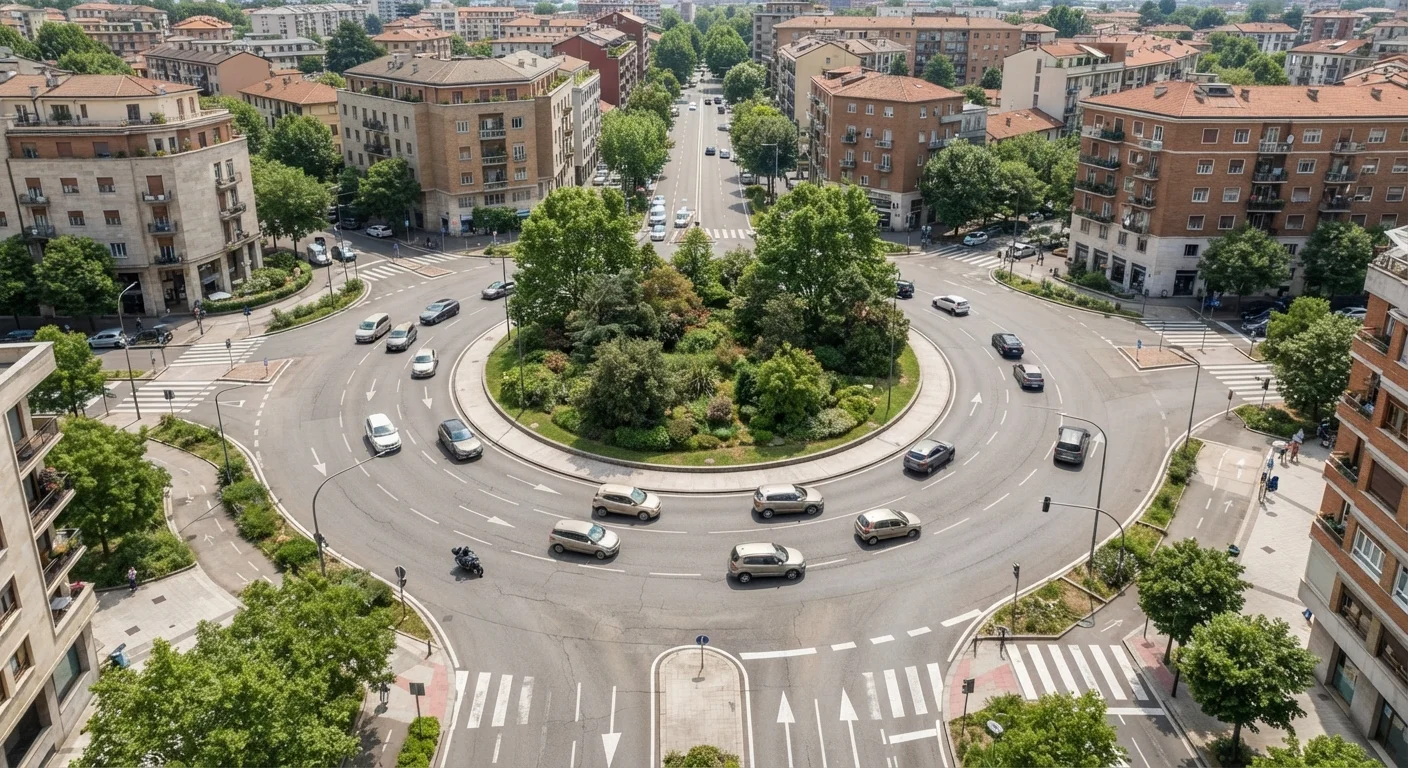
Single-lane roundabouts are forgiving. Multi-lane roundabouts are not. Once you're in the wrong lane, you have limited options without cutting across another vehicle's path. The core discipline is committing to your lane before entry and holding it all the way to your exit - the same principle that applies on any multi-lane road.
~40%
Reduction in injury crashes at converted intersections
The Federal Highway Administration has reported that converting conventional intersections to roundabouts typically reduces injury crashes by roughly 40 percent or more.
~75%
Reduction in fatal crashes at roundabout conversions
Fatal crash reductions at converted sites have been estimated at approximately 75 percent in FHWA-referenced studies, largely because roundabouts eliminate high-speed right-angle collisions.
Drivers who struggle with lane discipline in these environments often benefit from treating the roundabout approach like a motorway merge: read the road early, signal your intent, match your lane to your destination. For more on reading road layouts under pressure, road markings and signs every driver should read instantly covers the painted guidance that roundabout approaches use to direct lane choice.
Large Vehicles Need Extra Space in the Circle
Trucks, buses, and vehicles towing trailers may legally use the central apron (the raised mountable area at the center of some roundabouts) to complete their turn. If you see a large vehicle tracking wide inside the roundabout, give it room - do not attempt to pass on the inside. Squeezing past a turning truck in a confined circle is one of the more dangerous moves a driver can make at these junctions.
Roundabout confidence is ultimately part of a wider defensive mindset - the ability to read a situation before it becomes a conflict. Defensive driving techniques give you a framework for doing exactly that, wherever you're driving.