
Why Road Markings Carry Legal Weight
Most drivers can identify a stop sign or a red light without thinking. The markings painted on the pavement, however, are where knowledge tends to get fuzzy - and that fuzziness can mean traffic violations or collisions. Road markings in the US are standardized by the MUTCD, the federal reference that state transportation departments follow. That means a double yellow center line means the same thing in Oregon as it does in Florida.
| Federal standard governing US road markings | MUTCD (Manual on Uniform Traffic Control Devices) (Federal Highway Administration) |
| Color used for pavement markings separating opposing traffic | Yellow (MUTCD Chapter 3) |
| Color used for pavement markings separating same-direction traffic | White (MUTCD Chapter 3) |
| Sign shape for unconditional stop | Red octagon (MUTCD Section 2B) |
| Construction zone sign color | Orange diamond (MUTCD Chapter 6) |
| School zone sign shape | Yellow-green pentagon (MUTCD Section 2C) |
If you're still building foundational driving knowledge, this guide for first-time car owners covers the broader context - from documentation to maintenance basics.
Pavement Markings: Color and Pattern Decoded
Color and line style together communicate a specific instruction:
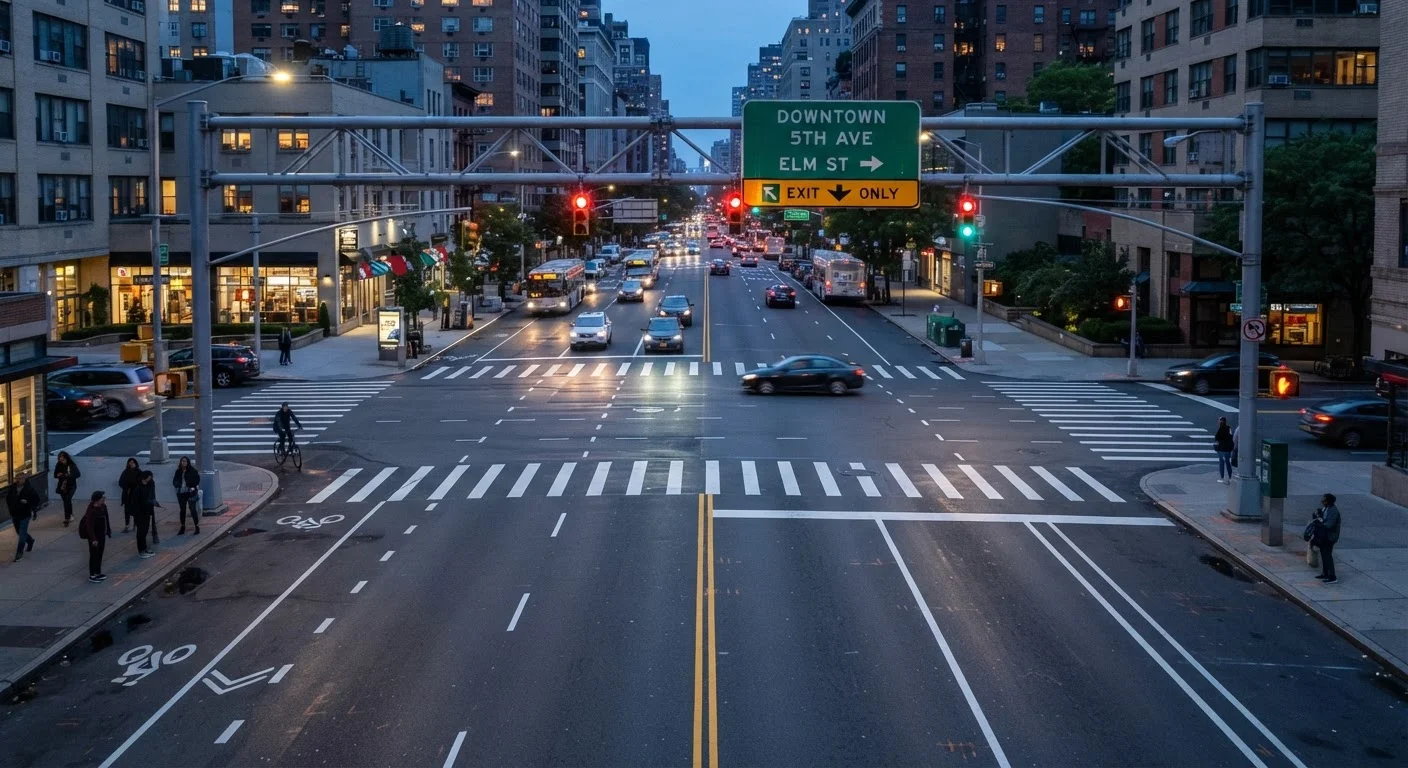
- White lines separate traffic moving in the same direction. Dashed white lines mark lane boundaries you may cross to change lanes. Solid white lines discourage lane changes (such as near an intersection). A wide solid white bar across your path is a stop bar - you must stop before it, not on it.
- Yellow lines separate opposing traffic. A single dashed yellow center line permits passing when clear. A double solid yellow line prohibits passing in either direction. A solid yellow line on your side of a dashed pair means passing is forbidden for you specifically.
- Crosswalk lines are wide white transverse bars. Pedestrians in a marked crosswalk have the right of way in all 50 states.
- Bicycle lane markings - a solid white border plus a bike symbol - legally designate a lane for cyclists. Driving or parking in a bike lane is prohibited except where explicitly signed (for turning, for example).
- Yellow diagonal hatching inside a box junction means you may not enter unless your exit is clear. Running a box junction is a ticketable offense in jurisdictions that enforce them.
MUTCD
Manual on Uniform Traffic Control Devices - the federal document that standardizes road signs, signals, and pavement markings across all US states. States may adopt stricter rules but must meet MUTCD minimums.
Stop bar
A wide white line painted across a lane at an intersection or crosswalk. Drivers must stop with their vehicle entirely behind this line, not on or past it.
HOV lane
High-Occupancy Vehicle lane - a restricted travel lane reserved for vehicles carrying a minimum number of occupants (typically two or more). Requirements and hours vary by location.
Two-way left-turn lane
A center lane marked with yellow lines and diamond symbols, shared by vehicles from both directions preparing to turn left. It is not intended for through travel.
Yield
A legal obligation to slow or stop and allow other vehicles or pedestrians with the right of way to proceed before you enter the roadway or intersection.
Box junction
A road marking - typically yellow diagonal hatching - indicating that a driver must not enter the marked area unless the exit ahead is clear, to prevent blocking cross traffic.
Regulatory and Warning Signs at a Glance
Sign shape is your first clue before you can read the text:
- Octagon (red) - Stop. Full stop, every time, even when the intersection appears clear.
- Triangle pointing down (red/white) - Yield. Slow and give way to cross traffic or merging vehicles.
- Circle (red X or R) - Railroad crossing with active signals. Stop when lights flash.
- Diamond (yellow or orange) - Warning. Orange diamonds indicate construction zones where fines are typically doubled.
- Pentagon (yellow-green) - School zone or school crossing. Reduced speed limits apply during posted hours, not just when children are visible.
- Rectangle - Regulatory (speed limits, turn restrictions) when vertical; guide or distance information when horizontal.
Orange Signs Mean Double Trouble
In most US states, fines for moving violations committed in active construction zones are legally doubled - sometimes tripled. Orange diamond warning signs are not suggestions. Slow to the posted construction zone speed limit whenever you see them, even if workers are not immediately visible. Work zone speed camera enforcement is also expanding across multiple states.
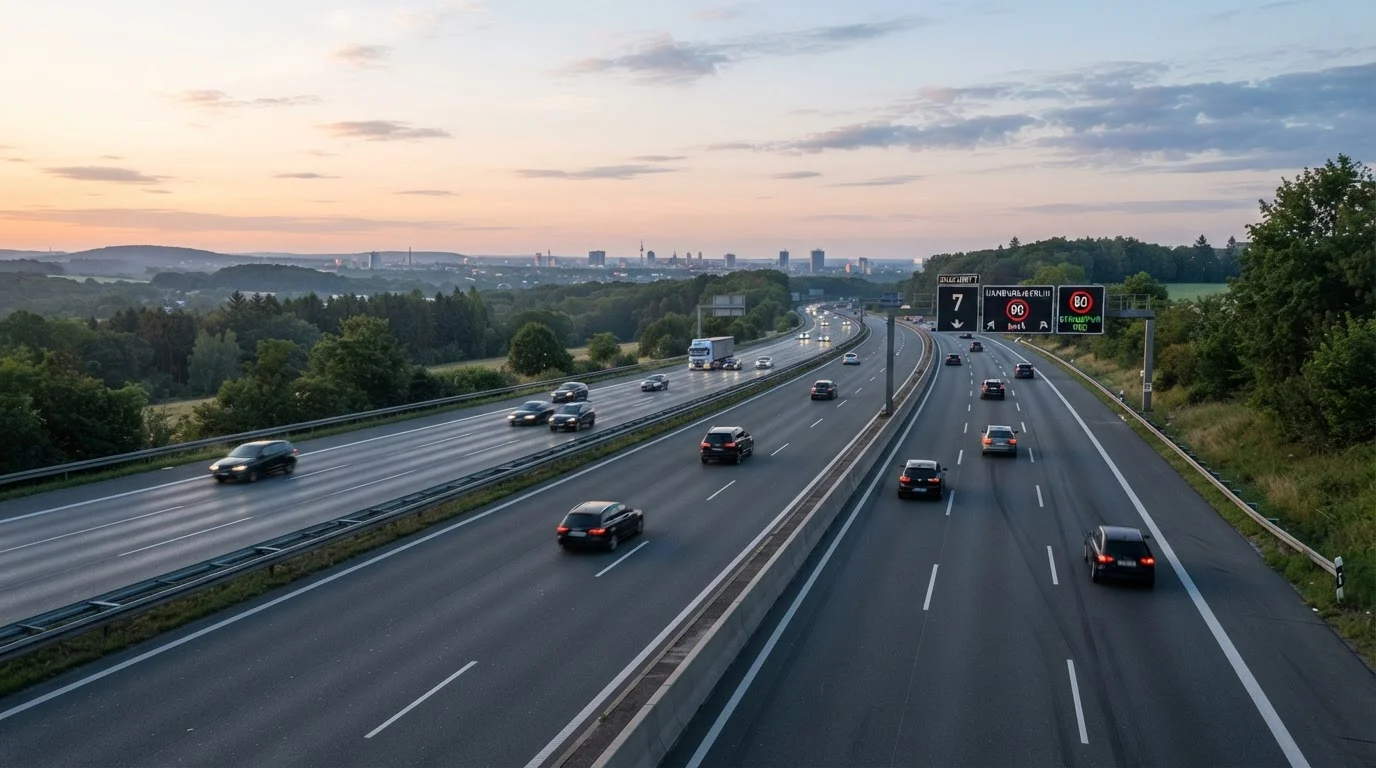
For driving situations where sign reading becomes critical at speed, see our article on motorway driving for the first time. And if roundabout signs and lane markings trip you up, roundabout rules explained clears up the most common points of confusion.
Quick Reference: What Each Marking Requires of You
~50%
Of traffic crashes involve lane-departure events
According to NHTSA research, lane departures - often linked to misread or ignored lane markings - are a factor in roughly half of fatal crashes annually.
812
Distinct sign types standardized in the MUTCD
The MUTCD catalogs over 800 sign types to ensure uniform driver comprehension across all US jurisdictions.
3-5 sec
Average driver recognition time for unfamiliar signs
Traffic safety research suggests drivers take several seconds longer to process non-standard or unfamiliar signs, underscoring why standardization matters.
A few markings are commonly misread and worth calling out specifically:
- Rumble strips
- Raised or grooved patterns on the shoulder or center line that vibrate the vehicle. They signal you have drifted - correct your lane position immediately.
- Shared center turn lane (two-way left-turn lane)
- Marked with solid and dashed yellow lines on both sides. It is legal to enter this lane only to prepare for or complete a left turn. It is not a travel lane or a merge lane.
- HOV lane markings
- Diamond symbols on the pavement designate High-Occupancy Vehicle lanes. Entry requirements (number of occupants, hours of operation) are posted on overhead or roadside signs and vary by state.
Your dashboard indicators work alongside road cues to keep you safe - understanding your warning lights is another fast-reference skill worth building.