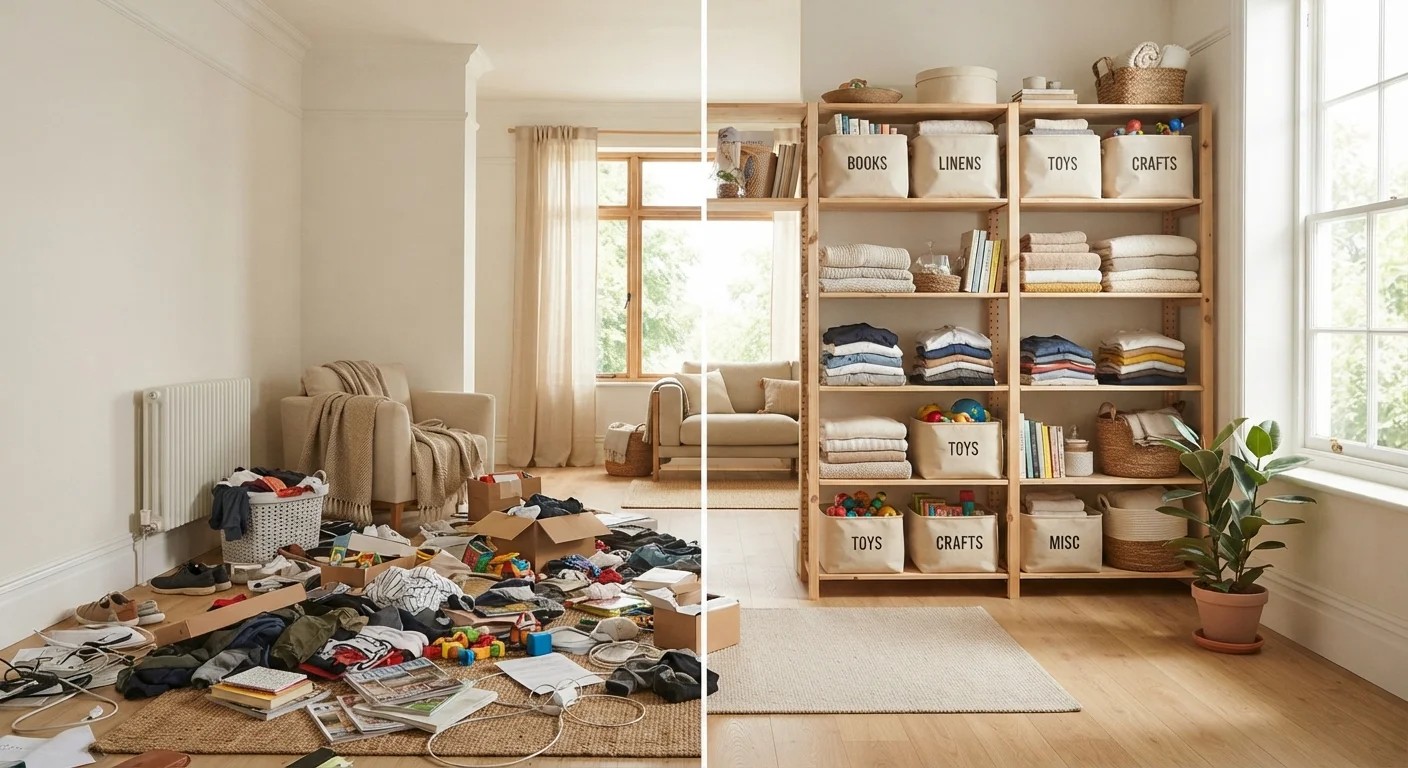


Why People Label Their Homes in the First Place
Home labelling - applying written, printed, or adhesive tags to containers, shelves, drawers, and bins - has grown from a niche organizing habit into a widely adopted practice, partly accelerated by the popularity of container-forward storage aesthetics on social media. But the core motivation is practical: labels reduce the mental effort of locating things and help everyone in a household put items back correctly.
The appeal is straightforward. When every container in a pantry is clear and unlabeled, identifying contents at a glance requires opening lids or squinting at bags. Labels short-circuit that friction. In shared homes, they also transfer tacit knowledge - the location logic one person has memorized - into something visible for everyone else. See our guide on decluttering vs. organizing for context on how labelling fits into a broader organizational sequence.
Understanding those motivations helps set realistic expectations. Labels are a communication tool, not a transformation. They work best when the underlying organization is already sound.
The Genuine Benefits of a Labelled Home
Reduces time spent searching for items
Labels turn location knowledge into a visible system, eliminating the need to open multiple containers or ask other household members. This is especially effective in pantries and storage closets with many similar-looking containers.
Supports correct item return in shared homes
When multiple people use a space, labels communicate where things belong without requiring verbal reminders. This reduces the drift that causes organized spaces to become disorganized over time.
Helps children learn and participate in tidying
Labels with words - or words paired with simple pictures for younger children - give kids the tools to find and return items independently, building habits that reduce parental follow-up.
Externalizes one person's organizational knowledge
In households where one person manages most of the storage logic, labels make that system accessible to everyone, reducing dependency on a single person's memory.
Reduces decision fatigue in high-rotation areas
Clearly labeled zones in areas like a craft room, workshop, or medicine cabinet mean users can act quickly without evaluating options, which is especially useful in time-pressured moments.
The strongest case for labelling lives in shared and high-rotation spaces. A pantry used by multiple family members, a utility closet accessed by everyone in the household, or a medicine cabinet with look-alike packaging are all places where labels meaningfully reduce errors and frustration. For households with children, labels serve a secondary purpose: they reinforce literacy and spatial reasoning by connecting words to physical locations.
Labels also have a practical role in homes where one person manages most of the organizational logic. If you are the primary person who knows where everything lives, a labeled system means the household doesn't grind to a halt when you're unavailable. That knowledge becomes external and shared rather than held in one person's memory. This connects directly to the friction points explored in why a tidy-looking home can still feel chaotic.
Where Labelling Creates More Work Than It Solves
Labels become inaccurate as storage use shifts
Household storage habits change over time, and a label that was accurate at setup can actively mislead once contents drift. Inaccurate labels are often worse than no labels at all.
Maintenance adds an ongoing time cost
Labels peel, fade, and require replacement. In a fully labeled home, keeping the system current can become a recurring task that erodes the time saved in day-to-day navigation.
Visual overload in living and rest spaces
Labelling every surface in areas meant for comfort - bedrooms, living rooms - can make those spaces feel clinical or cluttered in a different way, counteracting the calm that organization is supposed to create.
Can substitute for actual organizational thinking
It's possible to label a poorly organized space without actually improving how it functions. Labels applied before deciding what truly belongs somewhere often need to be redone shortly after.
Inconsistent formats create visual noise
Mixing label styles - handwritten in some areas, printed in others, embossed elsewhere - creates a patchwork appearance that looks more chaotic than organized, particularly in open or visible storage.
The downsides of labelling tend to emerge at the extremes - either labelling too much, or labelling in areas where contents change frequently. A drawer labeled "batteries" is useful right up until that drawer starts holding phone chargers, twist ties, and spare keys. At that point, the label becomes inaccurate and quietly confusing.
There's also a maintenance cost that's easy to underestimate at the outset. Labels peel, fade, and smudge. Printed labels require a printer, tape, and time to replace. Handwritten labels may become illegible. In households where storage needs shift seasonally or as family composition changes, a fully labeled system can demand regular revision - turning what was meant to save time into a recurring organizational chore.
When 'Obvious' Items Still Benefit from Labels
Some items seem self-evident but benefit from labeling in specific contexts - expiration-prone pantry goods, medication with similar packaging, or cleaning products stored together. If you're curious about what product labels themselves communicate, our reference on what household product labels actually mean covers common symbols and claims in plain language. Labels you add to your own storage serve a different purpose than manufacturer labels, but both benefit from being read carefully.
Visual overload is another real consideration. A space where every surface carries a label can feel bureaucratic rather than calm - particularly in living areas and bedrooms where the goal is rest and comfort, not efficiency. Surface organization that looks ordered can still feel chaotic when the underlying system doesn't match how people actually use the space.
Building a Labelling Strategy That Stays Manageable
Rather than labelling everything or nothing, a tiered approach tends to hold up better over time. Reserve labels for areas that meet two criteria: the space is used by more than one person, and the contents rotate or might be confused with something else. Pantry dry goods, bathroom cabinet compartments, utility and craft storage, and file or document boxes are strong candidates. Bedroom drawers in a single-occupant room, or shelves holding large, obviously identifiable items, generally don't need them.
Consistency in label format also matters. Mixing handwritten, printed, and embossed labels across the same space creates a visual patchwork that undercuts the calm effect labelling is supposed to provide. Choose one method and apply it uniformly in any given area. If your household's storage needs shift regularly - something common in homes with growing children or changing roommates - consider erasable or dry-erase labels rather than permanent adhesive options, so updates don't require a complete redo.
It also helps to integrate labelling decisions into the broader organizing process rather than treating them as a finishing touch. Labelling a drawer before deciding what actually belongs in it permanently is one of the most common reasons labels fall out of sync with reality. Organizing shared spaces works best when the labelling reflects consensus, not just one person's preference.
~30%
Time saved locating items in labeled storage
Organizational research generally suggests labeled systems reduce retrieval time in shared-use storage environments, though exact figures vary by household size and system consistency.
2-3 zones
Recommended labeled areas for most households
Professional organizers commonly suggest prioritizing two to three high-traffic, high-rotation areas rather than labeling an entire home to keep maintenance realistic.