

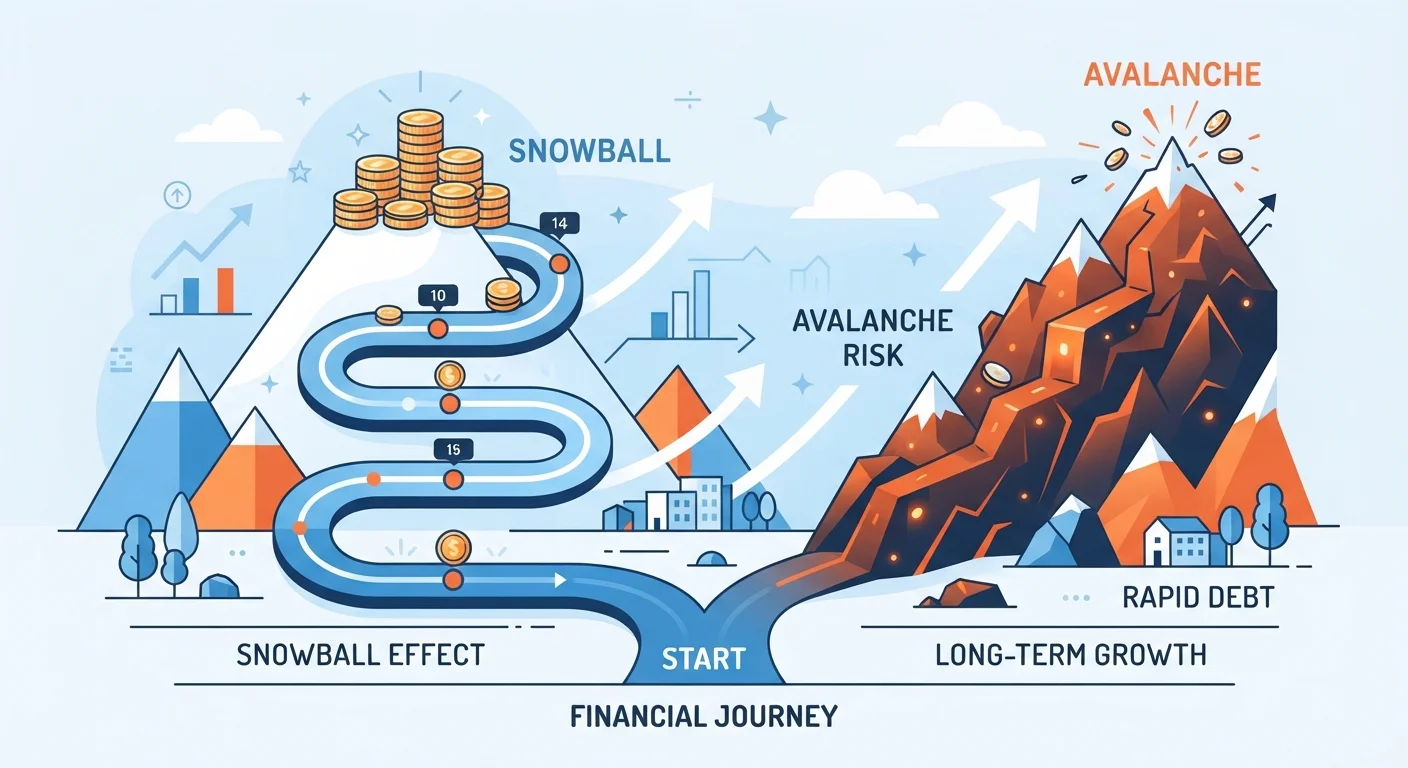
How Each Method Actually Works
Both the debt avalanche and debt snowball share the same core mechanic: you make minimum payments on all your debts, then direct any extra money toward one targeted account. The difference is purely in which debt gets that extra attention.
With the debt avalanche, you rank your debts by interest rate, highest to lowest. The debt costing you the most per dollar borrowed gets your extra payment first. Once that balance reaches zero, you roll that entire payment amount onto the next-highest-rate debt - and so on down the list.
With the debt snowball, you rank by balance size, smallest to largest, ignoring interest rates entirely. You clear the smallest debt first, then add what you were paying on it to the next-smallest balance. Each paid-off account rolls into a growing payment that eventually tackles larger debts.
Neither approach asks you to find extra money from thin air. Both work by systematically concentrating whatever you already have available. For a broader look at how these fit alongside building savings, see paying off debt while saving simultaneously.
| Criterion | Debt Avalanche | Debt Snowball |
|---|---|---|
| Payoff order | Highest interest rate first | Smallest balance first |
| Total interest paid | Generally lower | Generally higher |
| Time to first payoff | Potentially longer | Faster initial win |
| Psychological motivation | Relies on discipline | Built-in momentum |
| Best mathematical fit | Large rate differences between debts | Many small, separate balances |
| Complexity | Requires rate comparison | Simple balance ranking |
The Math vs. The Psychology
On paper, the debt avalanche almost always wins. By attacking the highest interest rate first, you reduce the amount of interest accruing on your overall debt load as quickly as possible. Depending on your specific balances and rates, the savings compared to the snowball method can be meaningful - sometimes hundreds or even thousands of dollars over the full repayment timeline.
But math alone doesn't determine whether a strategy succeeds. Behavioral research consistently shows that many people abandon debt repayment plans not because of math errors, but because progress feels invisible for too long. The debt snowball addresses this directly: eliminating a small balance entirely - even if it carries a lower rate - delivers a concrete, measurable win that can strengthen the habit of keeping up with the plan.
~$1,000+
Potential interest savings with avalanche vs. snowball
The gap between methods varies widely by balance size and rates, but can be substantial on high-rate credit card debt carried over several years.
33%
U.S. adults carrying credit card balances month to month
According to Federal Reserve survey data, roughly one in three American adults does not pay their credit card balance in full each month.
The practical question isn't which method is theoretically superior. It's which one you'll actually stick with long enough to finish. If a strategy that costs a bit more in interest leads you to full debt freedom, it still beats an optimal-on-paper approach that you abandon after three months. Consider reading about managing debt repayment without anxiety taking over if the emotional weight of this decision feels heavy.
Choosing Based on Your Situation
A few practical factors can help you lean one way or the other:
- High-rate debt dominates your list: If one or two accounts carry rates significantly above the others - credit cards at 24% alongside a car loan at 6%, for example - the avalanche's advantage grows considerably. Letting that high-rate balance compound longer costs real money.
- You have several small balances: If you're managing five or six separate accounts, the snowball's account-elimination effect can simplify your financial life meaningfully, even if it's not the cheapest path.
- Past plans haven't worked: Honest self-assessment matters. If you've started repayment plans before and stalled, the psychological scaffolding of the snowball may be worth its cost. Understanding the habits that keep people in a debt cycle can also clarify what's actually getting in the way.
- Your income and cash flow are stable: If your budget is predictable, the avalanche's longer wait for that first payoff is easier to tolerate. If income is variable, quick wins may provide more meaningful reassurance.
Before accelerating any repayment strategy, it's worth reviewing your overall readiness - including your emergency fund and income stability. The debt repayment readiness checklist walks through those fundamentals step by step.
Hybrid Approaches Are Valid Too
Some people combine both strategies: they use the snowball to eliminate one or two small accounts quickly, then switch to the avalanche for the remaining balances. This isn't a textbook method, but if it keeps you engaged and moving forward, it's a legitimate approach. The goal is debt freedom - the route is secondary.
This article is for general informational purposes only and does not constitute personalized financial advice. Please consult a qualified financial professional for guidance specific to your circumstances.