

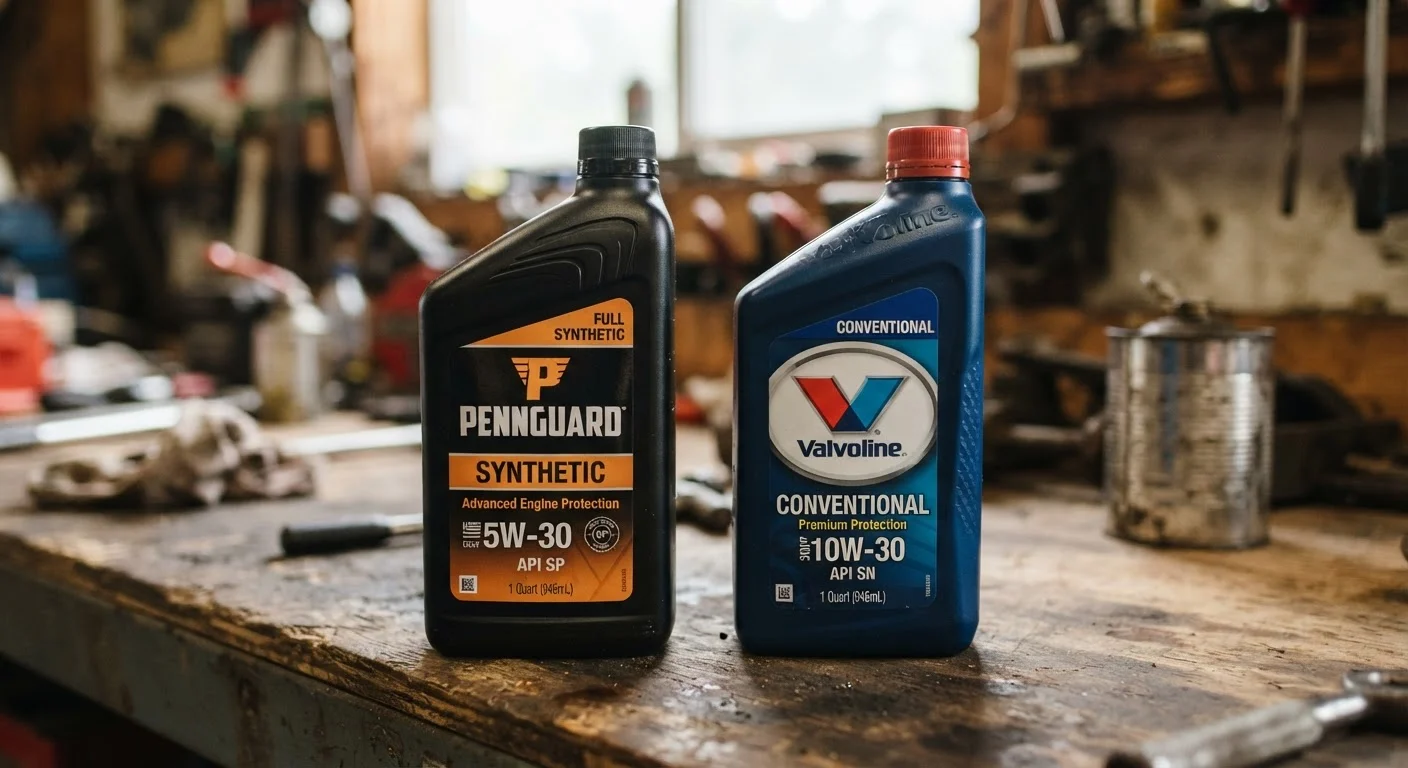
What Makes These Two Oils Different
Motor oil's primary job is to lubricate moving engine parts, reduce friction, carry away heat, and suspend contaminants until the next oil change. Both synthetic and conventional oil do this - but they're made differently, and that difference matters under real driving conditions.
Conventional motor oil is refined from crude petroleum. The refining process removes many impurities, but the resulting molecules are still irregular in size and shape. That inconsistency affects how the oil behaves under stress.
Synthetic motor oil is chemically built - either from a highly refined petroleum base or from non-petroleum feedstocks - to produce uniform, precisely engineered molecules. This gives synthetic oil more predictable, stable performance across a wider range of temperatures and loads.
There's also a middle category: synthetic blend oil, which mixes conventional and synthetic base stocks. It typically offers better protection than straight conventional oil at a lower price than full synthetic - a reasonable middle ground for some drivers.
| Criterion | Synthetic Motor Oil | Conventional Motor Oil |
|---|---|---|
| Base material | Chemically engineered molecules | Refined crude petroleum |
| Cold-weather flow | Flows readily at low temps | Thickens more in cold |
| Heat resistance | Higher thermal stability | Breaks down faster under heat |
| Typical drain interval | 7,500-10,000+ miles (varies by vehicle) | 3,000-5,000 miles (varies by vehicle) |
| Cost per quart | Higher upfront cost | Lower upfront cost |
| Best engine fit | Turbocharged, modern, or high-demand engines | Older, simpler engines in mild conditions |
Performance in Real Driving Conditions
The practical performance gap between these two oil types is most visible at the extremes. In cold weather, conventional oil thickens more than synthetic, meaning it takes longer to circulate fully when you first start the engine - a window when wear is most likely. Synthetic oil flows more readily at low temperatures, reaching critical engine components faster.
At the other end of the spectrum, high engine temperatures - common in turbocharged engines, stop-and-go city driving, and towing - accelerate the breakdown of conventional oil. Synthetic oil's engineered molecular structure holds up better under sustained heat, maintaining its protective film longer.
For most engines in moderate climates with normal commuting patterns, either oil type will do the job adequately when changed at the right interval. The gap widens when conditions get demanding. To understand what happens when oil degrades and changes are skipped altogether, see our guide to what happens inside your engine without an oil change.
~75%
New US vehicles requiring synthetic or synthetic blend
Industry estimates suggest the majority of new passenger vehicles sold in the US are factory-filled with synthetic or synthetic-blend oil.
5W-30
Most common viscosity grade in US passenger vehicles
5W-30 is among the most widely specified viscosity grades for light-duty vehicles in North America, though this varies by manufacturer and model year.
Cost: Upfront vs. Long-Term
Synthetic oil typically costs two to four times more per quart than conventional oil. For a standard passenger car oil change, that can mean paying noticeably more at the shop or auto parts store. But the cost comparison isn't that simple.
Because synthetic oil resists breakdown longer, many manufacturers approve extended drain intervals for vehicles using it - sometimes 7,500 to 10,000 miles or more, compared to the 3,000 to 5,000 miles often cited for conventional oil. Fewer oil changes per year can offset a significant portion of the per-quart price premium.
That said, the 3,000-mile change interval is more myth than mandate for most modern vehicles. Common car care myths, including that one, are worth examining before assuming how often your car actually needs service. Always defer to your owner's manual for the manufacturer-approved interval.
Switching Between Oil Types Is Generally Safe
A common concern is whether changing from conventional to synthetic - or back - can cause engine problems. For the vast majority of modern vehicles, switching is safe. Synthetic and conventional oils are chemically compatible. However, if your vehicle has a high-mileage engine or known seal issues, it's worth consulting a mechanic before making the switch, as some older engines have adapted to a specific oil over time.
How to Know Which Oil Your Engine Needs
The clearest answer is in your owner's manual. Manufacturers specify not just oil type (conventional, synthetic blend, or full synthetic) but also the viscosity grade - the numerical rating like 5W-30 or 0W-20 that describes how the oil flows at different temperatures. Using the wrong viscosity can reduce fuel economy and, in some cases, accelerate wear.
A few practical guidelines worth knowing:
- If the manual says synthetic is required, don't substitute conventional - some modern engines are built with tolerances that assume synthetic's protective properties.
- If the manual says conventional is acceptable, synthetic is typically a compatible upgrade, but it's worth confirming with a trusted mechanic for older or high-mileage vehicles.
- High-mileage oils - a variant of synthetic or synthetic blend - are formulated with seal conditioners for engines over roughly 75,000 miles, and may help reduce minor leaks or oil consumption in aging engines.
When in doubt, a certified mechanic can review your vehicle's specifications and driving conditions to help you make an informed choice. This is especially worth doing if you've recently purchased a used vehicle and aren't certain what oil type was used previously.