
What Each Approach Actually Involves
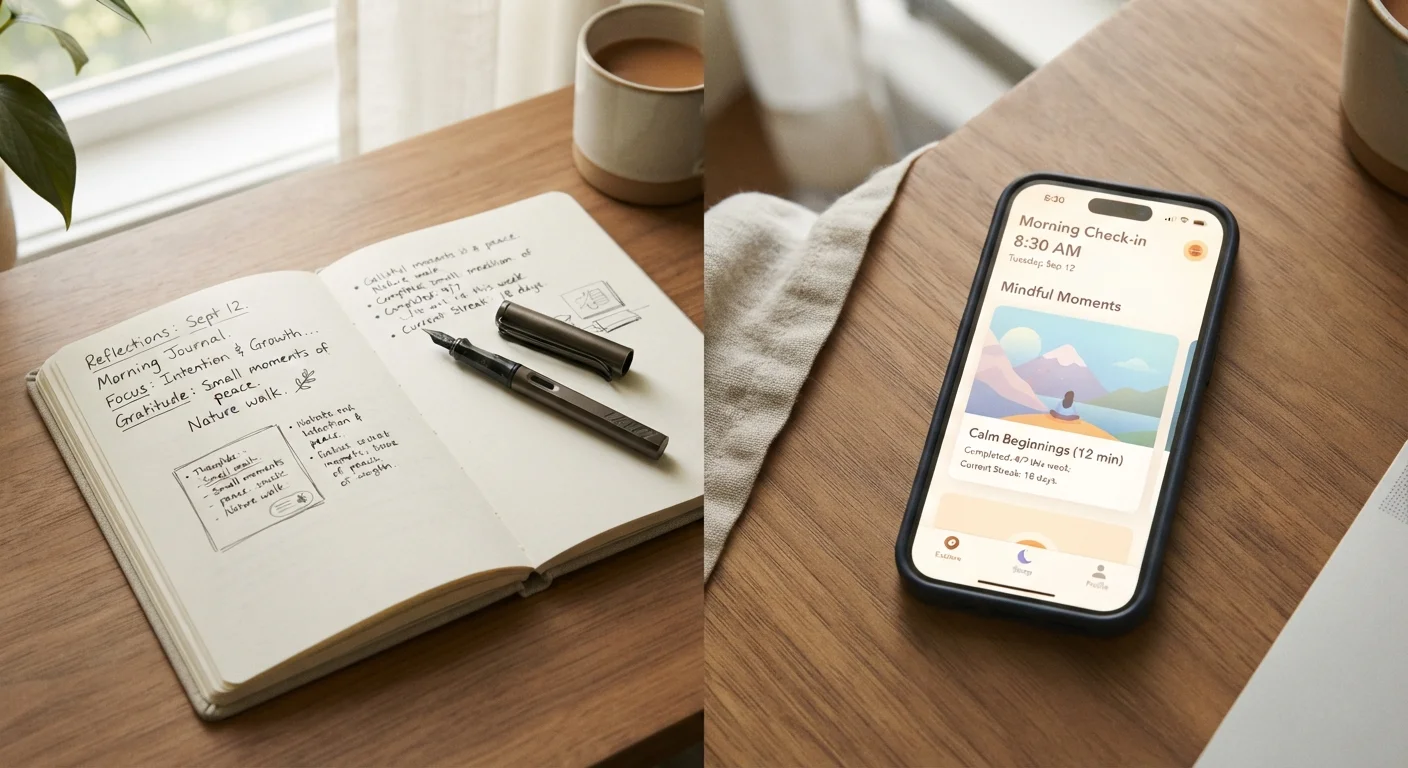
Pen-and-paper journaling is exactly what it sounds like: writing freely - or with self-chosen prompts - in a physical notebook. There are no accounts to create, no data to upload, and no set format. The practice can take five minutes or an hour, and the content is entirely up to the writer. Research consistently links expressive writing to benefits including reduced stress and improved emotional processing, though individual results vary considerably. For a deeper look at what the evidence says, see what the research actually shows about journaling.
Mental health apps - such as mood trackers, CBT-based journaling tools, or mindfulness companions - offer a guided digital experience. Most include daily check-in prompts, mood-rating scales, and some form of progress visualisation. Many are designed around evidence-informed frameworks like cognitive behavioural therapy (CBT) or dialectical behaviour therapy (DBT) principles, though the quality and clinical rigour vary widely between products. These apps sit within a broader ecosystem of mental wellness tools intended to support everyday emotional health, not replace clinical care.
This article is for general informational purposes only and does not constitute medical or mental health advice. If you are experiencing significant mental health difficulties, please consult a qualified healthcare professional.
Head-to-Head: Key Differences
The table below contrasts both approaches across the dimensions most people care about when starting a daily reflection habit.
| Criterion | Pen-and-Paper Journaling | Mental Health Apps |
|---|---|---|
| Structure | Fully self-directed | Guided prompts and templates |
| Consistency cues | None built in | Push notifications and streaks |
| Mood tracking | Manual, requires effort | Automated visualisations |
| Privacy | Entirely offline | Varies by app policy |
| Screen time | None | Adds to daily screen use |
| Cost | Low (notebook and pen) | Free to subscription-based |
| Accessibility | Requires literacy and fine motor ability | May offer voice input options |
One consideration often overlooked is privacy. A physical journal has no terms of service, no server breach risk, and no behavioural data sold to advertisers. App privacy policies vary - it is worth reviewing how any app stores and uses personal entries before committing. If managing digital clutter and app overload is a concern, the broader challenge of organising your digital life is worth thinking through before adding another tool to your device.
Consistency: The Factor That Matters Most
Across both formats, the single strongest predictor of benefit is whether someone actually does it regularly. A beautifully designed app left unopened delivers nothing; a notebook collecting dust on a nightstand similarly provides no value.
~80%
App users who lapse within two weeks
Research on mobile health apps broadly suggests the majority of users disengage within the first two weeks of downloading a new wellness app.
15-20 min
Typical expressive writing session in studies
Studies examining expressive writing benefits, including work associated with researcher James Pennebaker, typically used sessions of 15-20 minutes over several consecutive days.
Mental health apps generally have an edge in habit initiation - push notifications, streaks, and gentle check-in reminders reduce the friction of getting started each day. Journaling, by contrast, tends to reward people who already have some intrinsic motivation to write. That said, the analog format removes the temptation to drift into social media or other apps mid-session, which some people find makes focused reflection easier.
Reflection doesn't have to happen in isolation either. Pairing either habit with social habits that support mental wellbeing - like brief check-ins with a trusted friend - can reinforce the self-awareness both tools aim to develop. And for those building a broader routine, a daily self-care checklist can help anchor reflection alongside other foundational habits.
It is also worth noting that journaling and apps are not mutually exclusive. Some people use a quick app check-in to log their mood in the morning and a physical journal for deeper evening reflection. Neither format is a substitute for professional support - if symptoms are significant or persistent, speaking with a therapist remains the most evidence-supported route.