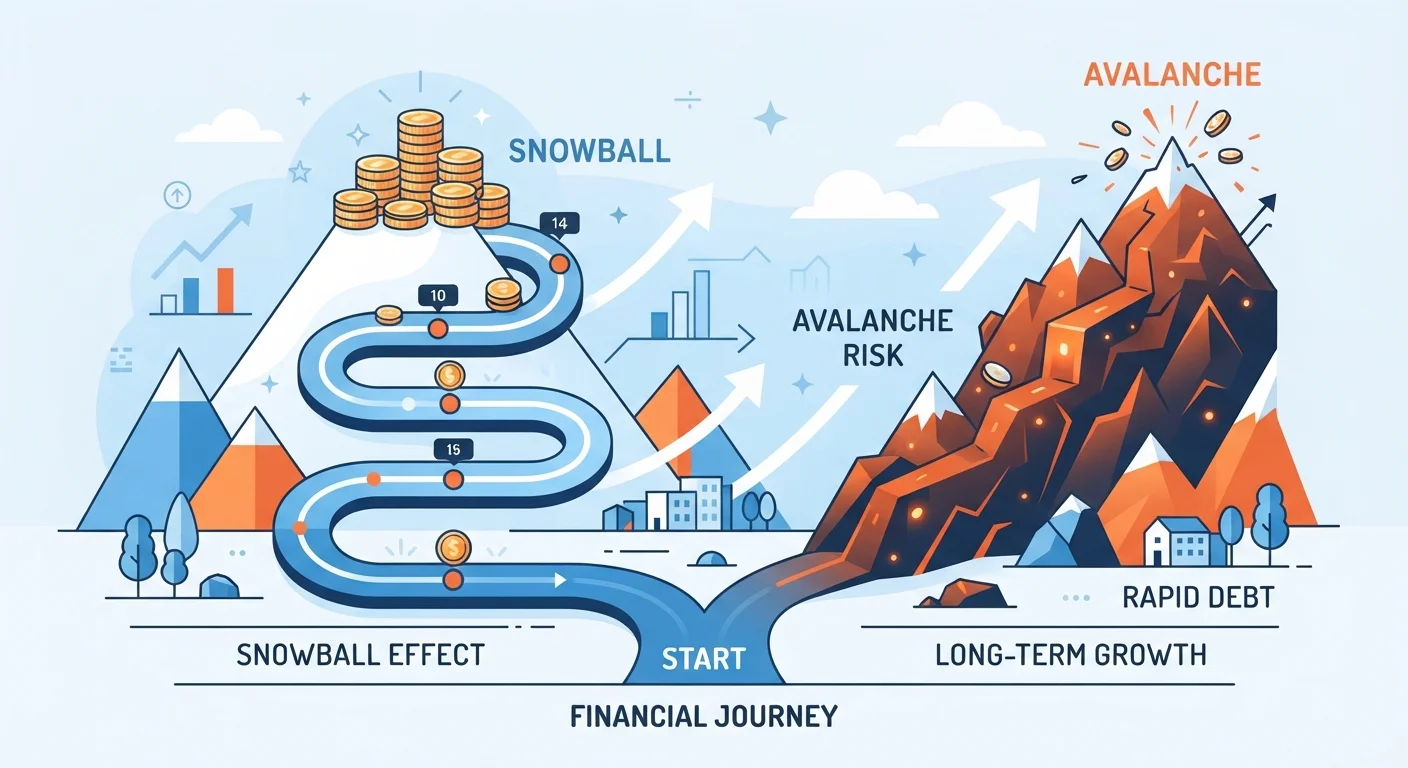


The Core Tension: Interest Rates vs. Human Behavior
On paper, the question of whether to save while in debt has a clean answer: if your debt's interest rate exceeds what your savings will earn, every dollar in a savings account costs you money. Credit card balances, for example, commonly carry interest rates well above what any standard savings account yields. Mathematically, paying that debt down first produces a better outcome.
But personal finance isn't a spreadsheet. Motivation, stress, and the fear of zero savings buffer all influence real decisions. That's why understanding the tradeoffs - not just the arithmetic - is the more useful starting point. For a deeper look at structured debt payoff strategies, see how the debt avalanche and snowball methods differ.
Builds a financial buffer against new debt
Even a small emergency fund reduces the likelihood that an unexpected expense forces you back onto a credit card, preventing the cycle of paying down and re-accumulating debt.
Sustains motivation during long debt payoff periods
A visible savings goal - a vacation, a down payment, a car - gives you a positive target to work toward, which can offset the psychological grind of purely eliminating debt.
Keeps time-sensitive goals on track
Some financial goals have windows that debt payoff timelines won't respect; saving in parallel ensures you don't indefinitely defer life milestones.
Low-rate debt reduces the opportunity cost
When debt interest is close to or below prevailing savings rates, the financial penalty for saving simultaneously shrinks significantly, making a dual strategy more defensible.
Builds the habit of consistent saving
Maintaining a savings routine even in small amounts can embed long-term financial habits that pay dividends well after debt is eliminated.
The Case Against Saving While in Debt
The financial cost of carrying debt while diverting money to savings is the most straightforward argument against the practice. Every month you hold a high-interest balance, the interest compounds - often faster than any savings growth offsets it.
High-interest debt erodes net worth faster
When debt carries double-digit interest and savings earn a fraction of that, every dollar in a savings account is effectively costing you money in the form of unpaid interest.
Slower debt payoff means more total interest paid
Diverting income from debt repayment extends the repayment period, and interest compounds throughout - sometimes adding hundreds or thousands of dollars to the total cost of the debt.
Split focus can blur financial priorities
Trying to serve two goals at once without clear allocation rules can lead to under-funding both, leaving debt lingering and savings too thin to matter.
Savings returns rarely outpace debt interest
Even competitive savings accounts rarely match the interest rate on consumer debt, so the financial argument for saving first is hard to make on pure return terms.
Can create a false sense of financial progress
Watching a savings balance grow can feel reassuring while a high-interest debt balance quietly grows too - a misleading picture of overall financial health.
20%+
Typical credit card APR in the US
The Federal Reserve tracks average credit card interest rates, which have exceeded 20% APR for general-purpose cards in recent years - far above standard savings account yields.
~4-5%
High-yield savings account APY range
High-yield savings accounts have offered competitive rates in certain rate environments, but these rates fluctuate and are not guaranteed to persist.
Beyond the raw cost, splitting your dollars can also slow visible progress on debt, which itself carries a motivational risk. Seeing your debt balance shrink slowly - or barely at all - can make the entire effort feel futile, paradoxically increasing the chance you'll abandon a plan altogether.
When Saving Alongside Debt Makes Sense
There are real scenarios where building savings while carrying debt is a defensible, even prudent, choice. The most compelling is the emergency fund argument: without any cash buffer, one car repair or medical copay can push you straight back onto a credit card, canceling out weeks of debt payoff progress. A modest emergency reserve - even a few hundred dollars - breaks that cycle.
Low-interest debt also changes the calculus. If your debt carries a rate close to what a high-yield savings account earns, the opportunity cost of saving narrows considerably. Tackling debt and building savings simultaneously isn't inherently contradictory in these conditions.
The Emergency Fund Exception
Most financial educators broadly recommend maintaining at least a small cash reserve - often cited as one to three months of essential expenses - even while paying down debt. The logic: without it, a single unexpected bill can restart the debt cycle. This is generally considered a reasonable baseline before accelerating savings toward other goals, though your ideal amount will depend on your income stability, expenses, and risk tolerance.
Time-sensitive goals - a down payment with a fixed window, a wedding, a move - add another dimension. Delaying these goals entirely until debt is gone may not be realistic, and a structured savings plan keeps those milestones achievable without derailing debt progress entirely.
Making a Split Strategy Work in Practice
If you decide to pursue both goals at once, structure matters. Start by listing all debts with their interest rates. Any balance above roughly 8-10% should generally receive priority over discretionary savings beyond a basic emergency fund - though that threshold is a general guideline, not a guarantee, and your own situation may differ.
Once you've defined a floor for debt repayment, allocate a fixed, smaller amount to your savings goal each month and treat it as non-negotiable. Automation helps enforce this consistency - see how automatic transfers can support steady financial progress for practical setup guidance. Revisit your allocation whenever your income, debt balances, or goal timeline changes.
For those starting from scratch, building a first budget around both debt and savings goals offers a practical entry point. And if an unexpected windfall arrives, weighing whether to pay down debt or pad savings can help you think through the decision clearly.
This article is for general informational and educational purposes only and does not constitute personalized financial, tax, or legal advice. Consult a qualified financial professional before making decisions based on your individual circumstances.