
How Each Framework Actually Works
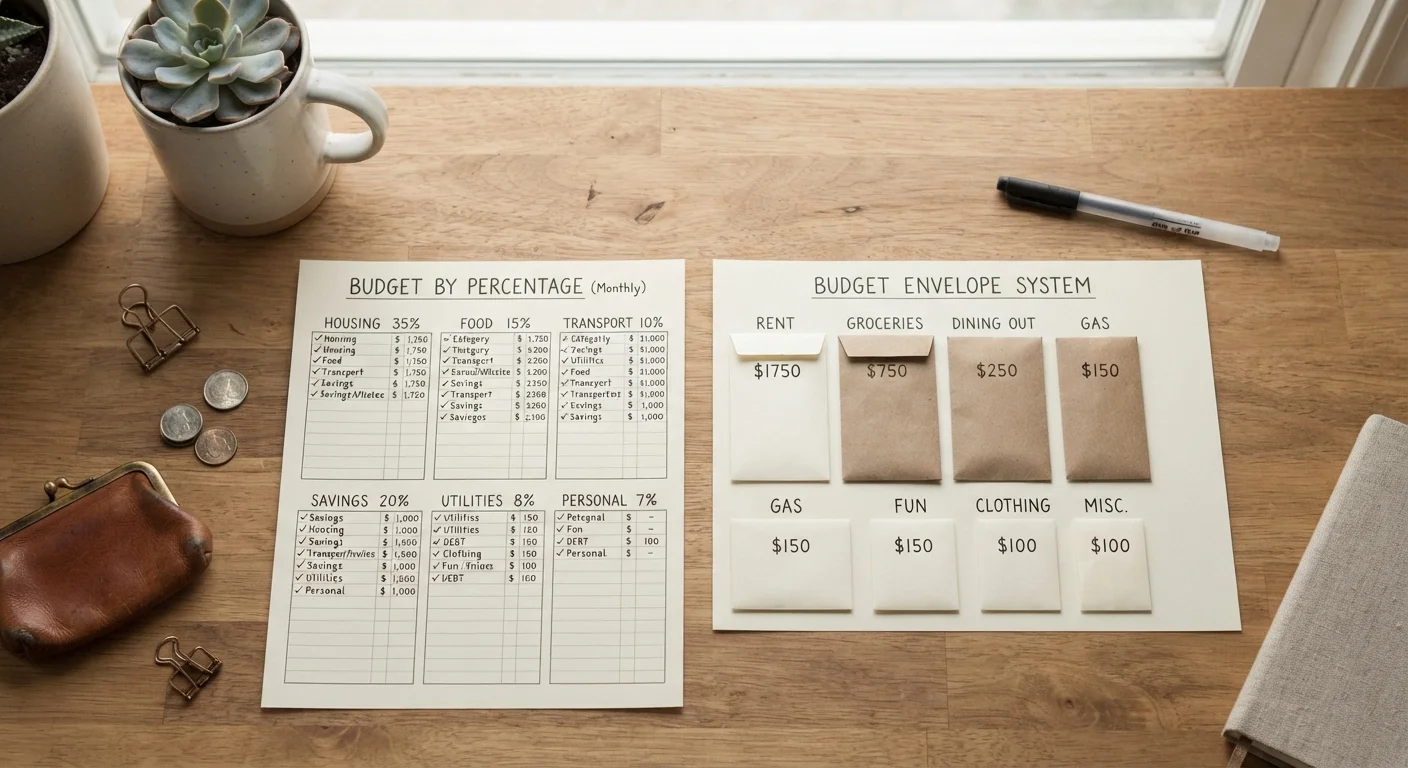
The 50/30/20 rule divides your after-tax income into three buckets: 50% for needs (housing, utilities, groceries, minimum debt payments), 30% for wants (dining out, subscriptions, entertainment), and 20% for savings and additional debt repayment. The appeal is simplicity - you don't track every transaction, just periodically check whether your spending stays roughly within those bands.
Envelope budgeting works differently. At the start of each month, you divide your income into specific categories - groceries, gas, clothing, dining, and so on - and assign a fixed dollar amount to each. Traditionally, you'd place physical cash in labeled envelopes. When an envelope is empty, spending in that category stops. Many people now replicate this digitally using spreadsheets or apps, which removes the need to carry cash. For a comparison of those tools, see spreadsheet vs. app-based budgeting.
Both systems share a core principle: decide where money goes before it gets spent, rather than reacting after the fact. The difference lies in how granular that decision-making is.
Strengths and Limitations Side by Side
Understanding where each framework excels - and where it struggles - makes it easier to choose one that actually sticks.
| Criterion | 50/30/20 Rule | Envelope Budgeting |
|---|---|---|
| Setup time | Minimal - three broad buckets | Higher - requires category list |
| Ongoing tracking effort | Low - periodic check-ins | High - monthly allocation and reconciliation |
| Spending control | Broad - category drift possible | Granular - hard limits per category |
| Works well for irregular income | Less suited - percentages shift with income | Well suited - allocate what you have |
| Flexibility for life changes | High - buckets adjust easily | Moderate - categories need updating |
| Helpful for debt payoff goals | Moderate - 20% includes debt repayment | Strong - dedicated category for debt |
| Beginner-friendly | Very - simple percentage targets | Moderate - requires spending estimates |
The 50/30/20 rule's biggest strength is accessibility. There's no category list to maintain, no envelope to refill, and no complex tracking required. Its limitation is precision: the broad buckets can mask overspending within a category. Someone spending 50% on needs but allocating most of that to discretionary subscriptions may feel on track while quietly undermining their savings.
Envelope budgeting's strength is control. Because every category has a hard limit, it's much harder to drift. Its limitation is upfront effort - creating the category system, assigning amounts, and reconciling each envelope takes meaningful time each month. It also requires accurate estimates of what you'll spend, which can be difficult for newer budgeters.
~33%
US adults without a formal budget
Surveys by the National Foundation for Credit Counseling have consistently found that a significant share of Americans do not maintain any formal budget, underscoring the value of any structured starting point.
1 in 3
Budgeters who report overspending monthly
Research from financial wellness organisations suggests roughly one-third of people who do budget still report regularly overspending in at least one category, highlighting the importance of category-level awareness.
Which One Tends to Work for Whom
The 50/30/20 rule tends to suit people with stable, predictable incomes who already have reasonable spending habits and mainly want a structural reference point rather than close oversight. It's also a reasonable starting point if you've never budgeted before and find the idea of tracking categories overwhelming.
Envelope budgeting tends to work better for people with a history of overspending in specific areas, those managing tight budgets where every dollar genuinely matters, or anyone trying to make rapid progress on a financial goal like building an emergency fund or accelerating debt repayment. See how emergency funds and budgets work together within a single plan.
Life stage also matters. A recent graduate tracking a starting salary may find envelope budgeting's category control more useful early on. A mid-career professional with stable cash flow may find the 50/30/20 rule's simplicity sustainable long-term. Budgeting approaches across different life stages explores this in more depth.
You Don't Have to Pick Just One
Many people find that a hybrid approach works well in practice. For example, using the 50/30/20 rule as a high-level target while applying envelope-style limits within the 'wants' bucket captures the simplicity of the former and the control of the latter. There is no rule requiring strict adherence to either framework. What matters is that the system you use reflects your actual income, expenses, and goals - and that you review it regularly. A monthly budget reset can help you course-correct before small gaps become larger problems.
This article is for general informational and educational purposes only and does not constitute personalised financial advice. For guidance specific to your circumstances, consider consulting a qualified financial professional.